Heathcliff reclaims his son Linton
Wuthering HeightsHeathcliff reclaims his son Linton is the decisive act through which the novel's central avenger converts his accumulated wealth and property into a weapon against the Linton line. Having already become master of Wuthering Heights by holding the mortgages Hindley Earnshaw signed to feed his gambling mania, Heathcliff now reaches across the social divide to Thrushcross Grange and demands the return of the boy he had never once seen. The action is not a gesture of paternal feeling but a calculated legal seizure, the first step in a scheme to make his sickly son the heir to both houses and thereby to swallow the Linton fortune whole. It is the moment the first generation's tragedy hardens into the second generation's captivity, and it sets the terms under which Catherine Linton will be lured, imprisoned, and forced into marriage.
The Legal and Economic Groundwork
The claim over Linton rested on a foundation of debt and foreclosure laid years earlier. Hindley Earnshaw, in his dissipation after the death of his wife Frances, had mortgaged every yard of land he owned to supply his mania for gaming, and Heathcliff had become the mortgagee. When Hindley died, the whole property was mortgaged, and the lawyer advised that the sole chance for the natural heir, Hareton, was to allow him an opportunity of creating some interest in the creditor's heart, so that he might be inclined to deal leniently towards him. That hope proved vain. Heathcliff held firm possession and proved to the attorney, who in turn proved it to Edgar Linton, that Earnshaw had mortgaged everything; in that manner Hareton, who should have been the first gentleman in the neighbourhood, was reduced to a state of complete dependence on his father's inveterate enemy, living in his own house as a servant, deprived of the advantage of wages, quite unable to right himself because of his friendlessness and his ignorance that he had been wronged. The same economic ruthlessness that had stripped Hareton of his inheritance now armed Heathcliff with the means to claim his own son, for the wealth that increased every year, of which nobody knew the amount, gave him the power to act without regard for Edgar Linton's wishes or the boy's welfare.
The Nighttime Summons
The actual reclamation begins as a violation of domestic peace. Linton has just arrived at Thrushcross Grange, having been brought there by Ellen Dean after the death of his mother, Isabella. The boy is a fretful, ailing charge, and Edgar Linton watches him with hope, remarking that the company of a child of his own age will instil new spirit into him soon, and that by wishing for strength he will gain it. Ellen Dean, however, is full of misgivings, wondering how ever that weakling will live at Wuthering Heights, between his father and Hareton, and what playmates and instructors they will be. Her doubts are decided even earlier than she expected. On the very evening of the boy's arrival, after tea is finished and Linton has been put to sleep, a maid steps out of the kitchen to inform her that Heathcliff's servant Joseph is at the door. Joseph, donned in his Sunday garments with his most sanctimonious and sourest face, holding his hat in one hand and his stick in the other, pushes past Ellen into the library and plants himself at the far side of the table, his two fists clapped on the head of his stick, and begins in an elevated tone, as if anticipating opposition: 'Hathecliff has sent me for his lad, and I munn't goa back 'bout him.'
Edgar Linton's Surrender
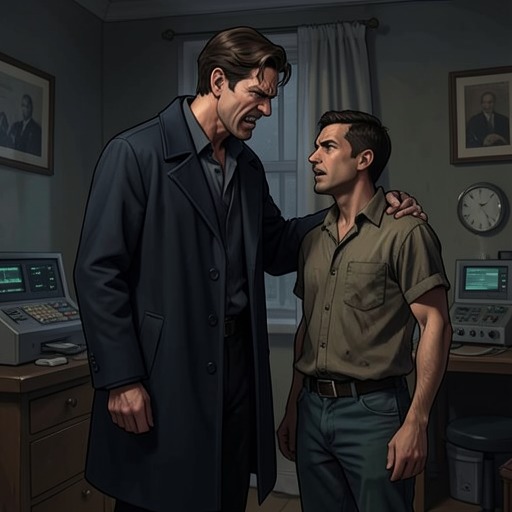
Edgar Linton is silent for a minute, an expression of exceeding sorrow overcasting his features. He would have pitied the child on his own account, but recalling Isabella's hopes and fears, and anxious wishes for her son, and her commendations of him to his care, he grieves bitterly at the prospect of yielding him up and searches in his heart how it might be avoided. No plan offers itself: the very exhibition of any desire to keep him would have rendered the claimant more peremptory. There is nothing left but to resign him. He answers calmly that his son shall come to Wuthering Heights tomorrow, that he is in bed and too tired to go the distance now, and that the mother of Linton desired him to remain under his guardianship, and that at present his health is very precarious. Joseph will have none of it. 'Noa!' he says, giving a thud with his prop on the floor and assuming an authoritative air. 'Noa! that means naught. Hathecliff maks noa 'count o' t' mother, nor ye norther; but he'll heu' his lad; und I mun tak' him—soa now ye knaw!' Edgar Linton answers decisively that Joseph shall not take the boy that night, and orders Ellen to show him down. Joseph withdraws slowly, shouting back, 'Varrah weell! To-morn, he's come hisseln, and thrust him out, if ye darr!'
The Removal at Dawn
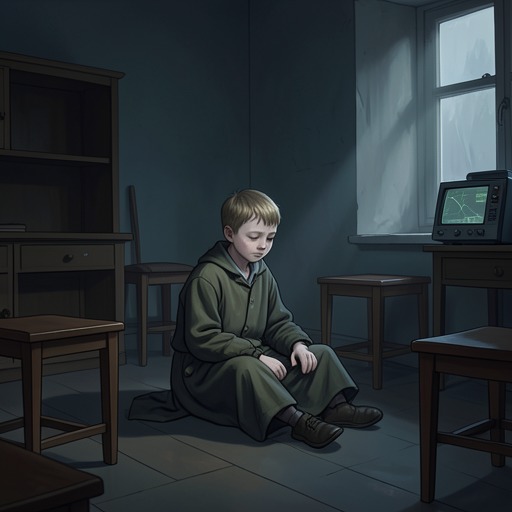
To obviate the danger of this threat being fulfilled, Edgar Linton commissions Ellen Dean to take the boy home early, on Catherine's pony. He instructs her to say nothing of where the boy is gone to his daughter, for she cannot associate with him hereafter, and it is better for her to remain in ignorance of his proximity, lest she should be restless and anxious to visit the Heights. She is merely to tell her that his father sent for him suddenly, and he has been obliged to leave them. Linton is very reluctant to be roused from his bed at five o'clock and astonished to be informed that he must prepare for further travelling, but Ellen softens off the matter by stating that he is going to spend some time with his father, Mr. Heathcliff, who wished to see him so much that he did not like to defer the pleasure till he should recover from his late journey. The boy's response reveals the full cruelty of the arrangement: 'My father!' he cries, in strange perplexity. 'Mamma never told me I had a father. Where does he live? I'd rather stay with uncle.' The child who has never known he had a father is delivered, at dawn, to a man who wants him only as a legal instrument.
The Design Revealed
Heathcliff's purpose in reclaiming his son is soon made explicit. When Ellen Dean later confronts him about encouraging Catherine Linton to visit the Heights, he declares that his design is as honest as possible and informs her of its whole scope: that the two cousins may fall in love and get married. He claims to be acting generously to her master, for his young chit has no expectations, and should she second his wishes she will be provided for at once as joint successor with Linton. When Ellen objects that if Linton died, and his life is quite uncertain, Catherine would be the heir, Heathcliff corrects her: there is no clause in the will to secure it so; his property would go to him, but to prevent disputes, he desires their union and is resolved to bring it about. The reclamation of the son is thus revealed as the first move in a larger strategy of dynastic absorption, in which the sickly boy is a pawn to be married to Catherine so that her inheritance, and the Linton estate, will fall into Heathcliff's hands.
The Consolidation of Power
The consequences of this action unfold over the following years. Edgar Linton, divining that one of his enemy's purposes was to secure the personal property as well as the estate to his son, or rather himself, feels that his will had better be altered: instead of leaving Catherine's fortune at her own disposal, he determines to put it in the hands of trustees for her use during life, and for her children, if she had any, after her, so that it could not fall to Heathcliff should Linton die. But the legal precautions come too late. After Linton's death, Heathcliff goes up to Catherine once to show her Linton's will, by which the boy had bequeathed the whole of his, and what had been her, moveable property to his father, the poor creature having been threatened or coaxed into that act during her week's absence when his uncle died. The lands, being a minor, Linton could not meddle with, but Heathcliff has claimed and kept them in his wife's right and his also, and Catherine, destitute of cash and friends, cannot disturb his possession. The reclamation of the son, which began as a nighttime demand and a dawn removal, ends with the complete transfer of the Linton inheritance into the hands of the man who had been brought to Wuthering Heights as a nameless foundling. When Heathcliff himself finally dies, Joseph falls on his knees and returns thanks that the lawful master and the ancient stock are restored to their rights, but the restoration comes only after the property has passed through the hands of the usurper, and the ancient stock is represented by Hareton, the boy who was reduced to a servant in his own house by the very same economic machinery that Heathcliff used to reclaim his son.